
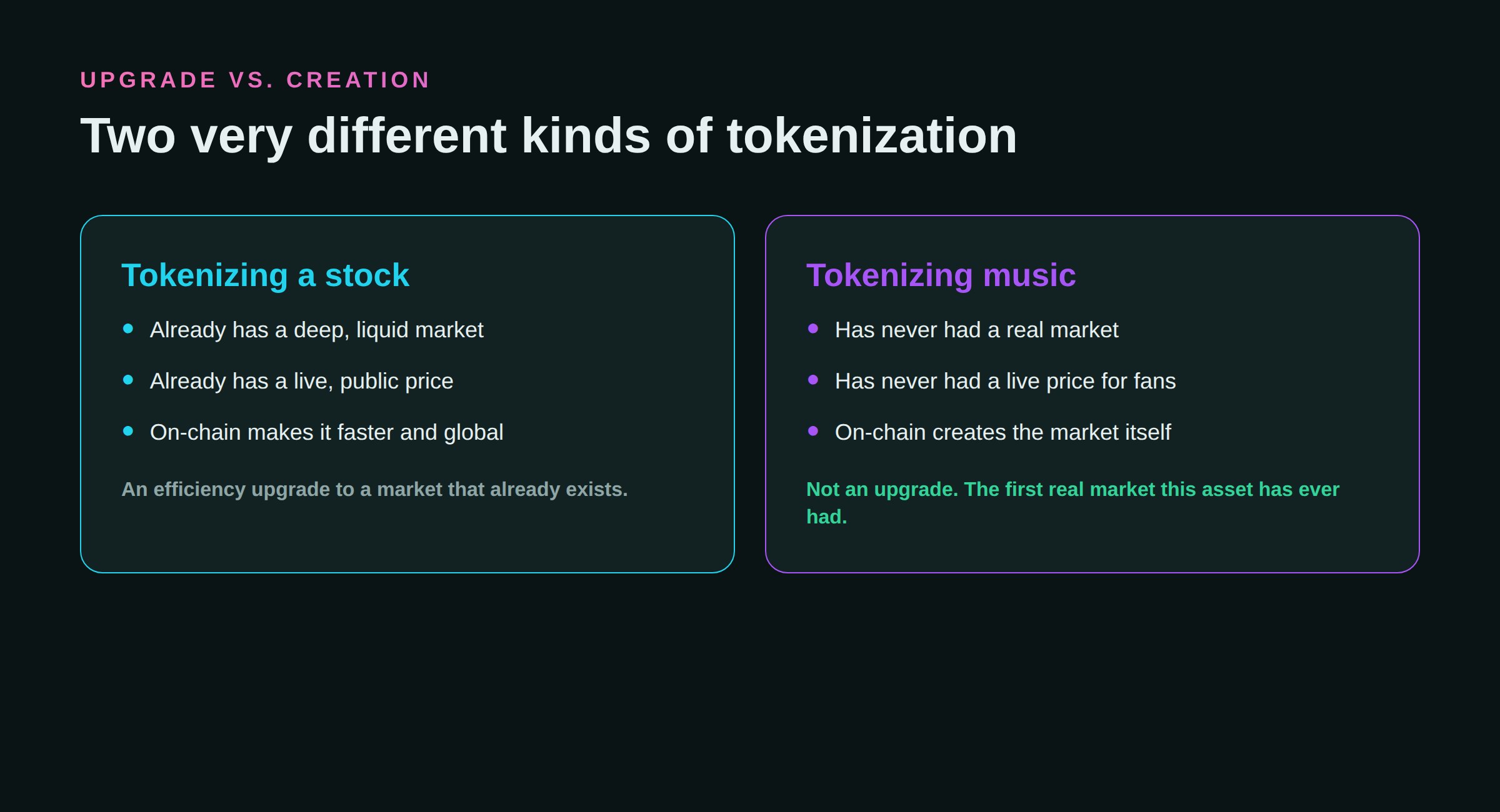
Every wave of tokenization so far has done the same quiet thing: it has taken a market that already exists and put it on faster rails. Treasuries, equities, gold, credit, real estate. All of these already had prices, buyers, sellers, and exchanges. Tokenizing them is a real upgrade, instant settlement, global access, round-the-clock trading, but it is an upgrade to something that already worked.
Music is different, and that difference is the whole opportunity. Music is not a market waiting to be upgraded. It is an asset class that has never had a market at all. Tokenizing it does not make an existing thing faster. It creates something that has never existed: a live, liquid, open market where the value of a song can finally be owned, priced, and traded by the people who actually love it.
That is a bigger deal than it sounds. New markets are rare. Most of finance is the same handful of asset classes traded in ever-more-efficient ways. Genuinely new asset classes, things people can own that they never could before, come along once in a generation. Music is one of them, hiding in plain sight, loved by billions, owned by almost no one.
An asset everyone consumes and no one can own
Think about your relationship with music versus your relationship with a stock. Almost nobody has an emotional bond with a share of an index fund. Almost everybody has a song that means something to them. Music is the most universal asset on earth. It crosses every country, language, and income bracket, and people engage with it every single day.
And yet, of all that devotion, fans capture zero of the upside. You can stream a song ten thousand times, tattoo its lyrics on your arm, and take it to number one by sheer word of mouth, and you will never own a cent of it. The value you help create flows entirely to labels, funds, and rights holders. The people closest to the music, the fans and often the artists themselves, are the ones locked out of owning it.
This is not because music lacks value. Recorded music is a multi-billion-dollar industry that grows every year, and catalogs now trade between private equity firms and specialist funds for hundreds of millions. The value is obvious. What is missing is a market that lets ordinary people in.
Why music never had a market
If the value is so clear, why has music never been ownable the way a stock is? Three reasons.
First, the rights are a tangle. A single song can be split across writers, performers, producers, publishers, labels, and distributors, a web of overlapping claims that scares off anyone trying to package it cleanly.
Second, a song does not look like a financial instrument. There is no share, no ticker, no order book, no exchange. There was never a standard unit to trade, because a song was never structured as something tradeable in the first place.
Third, and most importantly, the one time crypto reached for music, it reached for the wrong tool. It reached for NFTs. But an NFT treats a song as a scarce, one-of-a-kind collectible, and a song is the opposite of scarce. A song's value comes from how much it spreads, not from how rare it is. Wrapping a song in a one-of-one was a category error, so the experiment fizzled and the industry moved on to easier assets.
The result: the most universal asset on the planet still has no market for the people who care about it most.
A new asset class needs a new kind of token
Creating this market is not about securitizing a catalog for funds. That already exists, and it keeps ordinary people out by design. A new asset class means a new unit of ownership, one built around what a song actually is.
That unit is the AFT, the Audio Fungible Token.