
Long before crypto, before the stock market as we know it, people stored wealth in things they could hold. Rare art. Fine wine. First-edition books. Vintage instruments. Trading cards. These collectibles have quietly been one of the most durable stores of value for more than a hundred years, often holding up through wars, crashes, and currency collapses that wiped out other assets.
And yet almost nobody can actually use them as the asset they are. Three old problems have kept collectibles locked away from everyone but the wealthy and the well-connected. They are worth naming plainly, because they are the exact problems on-chain markets were born to solve.
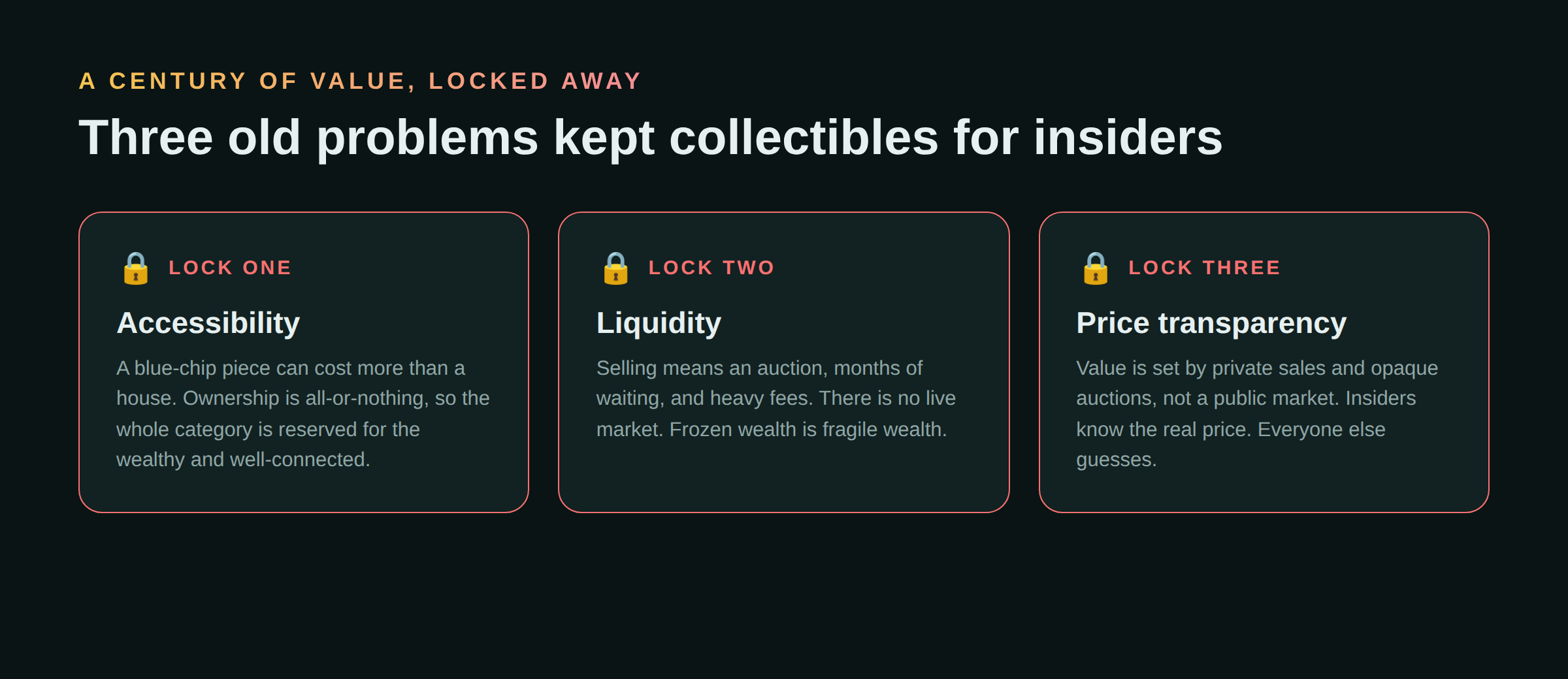
Problem one: accessibility
A blue-chip painting or a grail-tier collectible can cost more than a house. That single price tag locks out almost everyone. You cannot own a slice of a masterpiece the way you can own a slice of a company through a share. Ownership is all-or-nothing, so the whole category is reserved for people who already have serious money. The value is real, but the door is closed to nearly everyone standing outside it.
Problem two: liquidity
Even if you own something valuable, turning it back into money is slow and painful. Selling a collectible often means an auction house, months of waiting, heavy fees, and a buyer who may or may not show up at the price you want. There is no live market you can step into and out of. Your wealth is real, but it is frozen, and frozen wealth is fragile wealth. When you need to move, you often cannot, or you take a brutal discount to do it quickly.
Problem three: price transparency
What is any given collectible actually worth today? Usually nobody knows for sure. Prices are set by occasional private sales, opaque auctions, and expert opinion, not by a continuous, public market. Two similar items can sell for wildly different amounts, and the average person has no reliable way to see fair value. Without transparent pricing, the market tilts toward insiders who know what things really trade for, and against everyone else.
The same three locks, on a new asset class
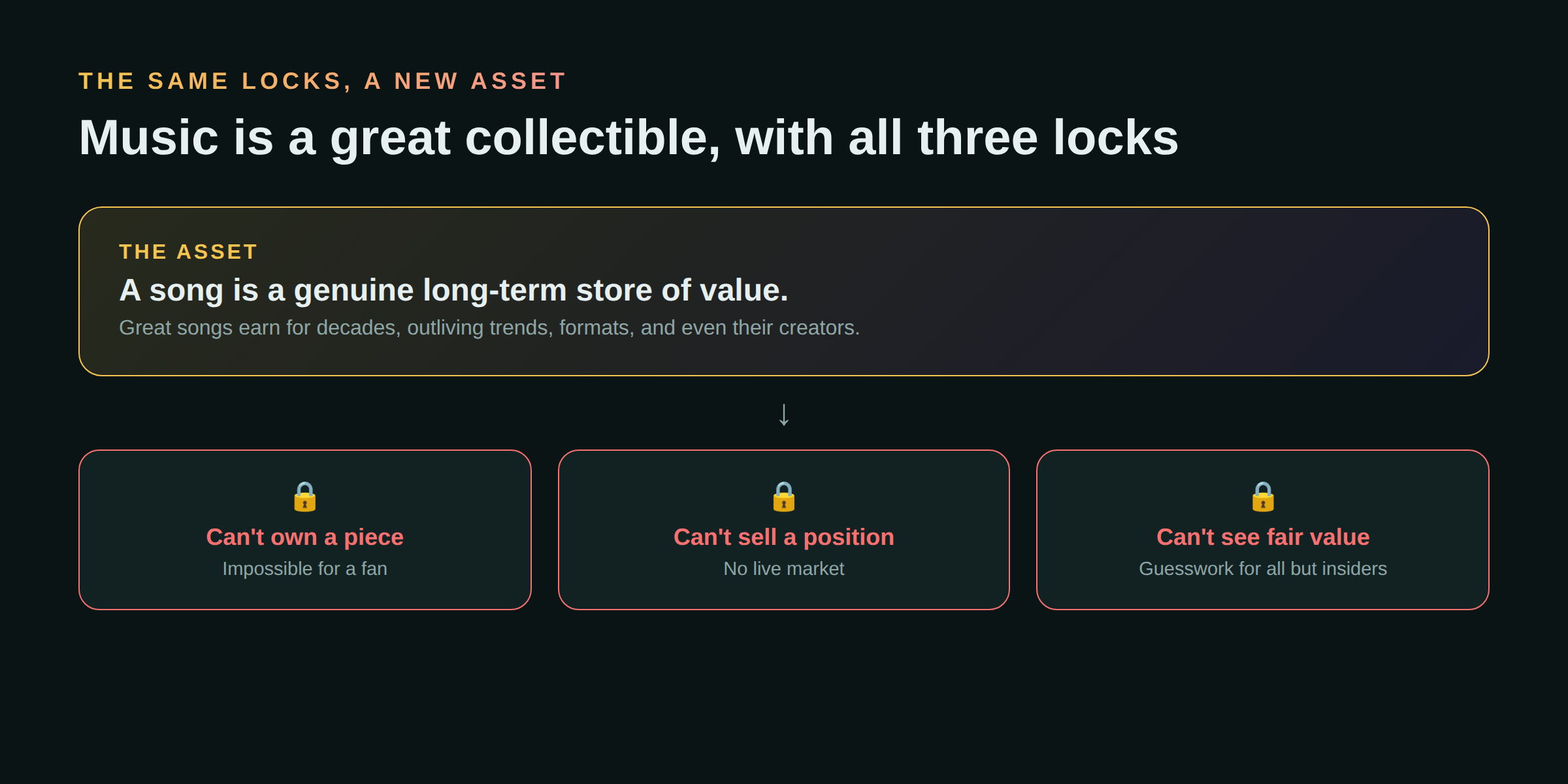
Here is why this matters for what we are building. Music has all the strengths of a great collectible and all three of the same locks.
A song is a genuine long-term store of value. Great songs earn for decades, outliving trends, formats, and even their creators. But owning a piece of that value has been impossible for a fan, selling it has been impossible, and knowing what a catalog is really worth has been guesswork for all but a handful of insiders. Accessibility, liquidity, price transparency. The oldest problems, on one of the oldest and most beloved assets there is.
What changes when the asset goes on-chain

On-chain markets are, at their core, a solution to exactly these three problems, and Riffdex applies that solution to music.
Accessibility becomes fractional. A song becomes an AFT, a divisible token, so a fan can own a small piece instead of needing to buy the whole thing. The door opens to everyone.
Liquidity becomes instant. Instead of an auction and a wait, there is a live market. You can buy or sell a position in seconds, at a price the market is actually offering right now.
Price transparency becomes default. A continuous, public market means a real, visible price at every moment, set by everyone, not whispered between insiders. Fair value stops being a secret.
The lesson from a century of collectibles is not that they were a bad store of value. They were a great one. The lesson is that being a good store of value is not enough if almost no one can access it, sell it, or even see what it is worth. Solve those three, and you do not just improve an asset. You unlock it for everyone who was locked out.
That is what putting real value on-chain is really for. And music, the most global and beloved collectible of all, is where it should start.
Written by Melk — artist name of Stephen Heuvel, a self-taught builder and musician from Suriname, and the founder of Riffdex. I was one of the first artists to turn my music into an NFT (over 200 sold in a single day). It never felt right, so I spent the next two years building what music actually deserved: the AFT. Follow the build: @MelkRhm · Riffdex on X · Farcaster
Enjoyed this? Subscribe to get new posts on Riffdex, AFTs, and the future of music in your inbox.