Look at almost any industry from twenty years ago, and you'll barely recognize it. How we bank, shop, travel and get our news has been rebuilt from the ground up, sometimes more than once.
Music has changed too, but mostly in one direction. Streaming changed how we listen. Social media changed how we discover. Home studios and distributors changed who gets to release. Each of those shifts gave artists more reach. Very few of them gave artists more control over how they get paid, or a deeper relationship with the people who love their music.
I'm writing this as an artist first. I've released my own music, sold it to fans, and felt the gap between the attention a song gets and what actually comes back. This piece isn't about villains. Streaming services, labels, venues and distributors are all working inside a system built for a different era. But it's worth being clear about the facts, because when you put them side by side, a change isn't just likely. It's overdue.
Here's what artists are saying, in their own words and in the data.
"I can't live off my music"

This is the most common complaint, and the numbers back it up.
Ditto Music's Independent Music Report 2026 surveyed more than 5,000 independent artists across 112 countries. 74% earned less than $1,000 from music in the past year. Only 9% earned $5,000 or more. 64% hold a job outside music, and only 22% say music is their full-time job. A third considered quitting music in the past twelve months.
It isn't only emerging artists. The UK's Musicians' Census, run by Help Musicians and the Musicians' Union with nearly 6,000 working musicians, found that 43% earned less than £14,000 a year from music, and more than half needed income from outside music to keep their careers going.
These aren't hobbyists. They're people releasing music, building audiences and showing up, and most still can't make it pay.
"Streaming pays fractions of a cent"
To be fair, streaming saved recorded music. Global recorded music revenue reached $31.7 billion in 2025, the eleventh straight year of growth, and streaming is the engine of it. Spotify alone paid out more than $11 billion in 2025. The 100,000th highest-earning artist on Spotify earned more than $7,300 last year, compared with about $350 in 2015. Roughly half of Spotify's royalties were generated by independent artists and labels. That's real progress, and it deserves credit.
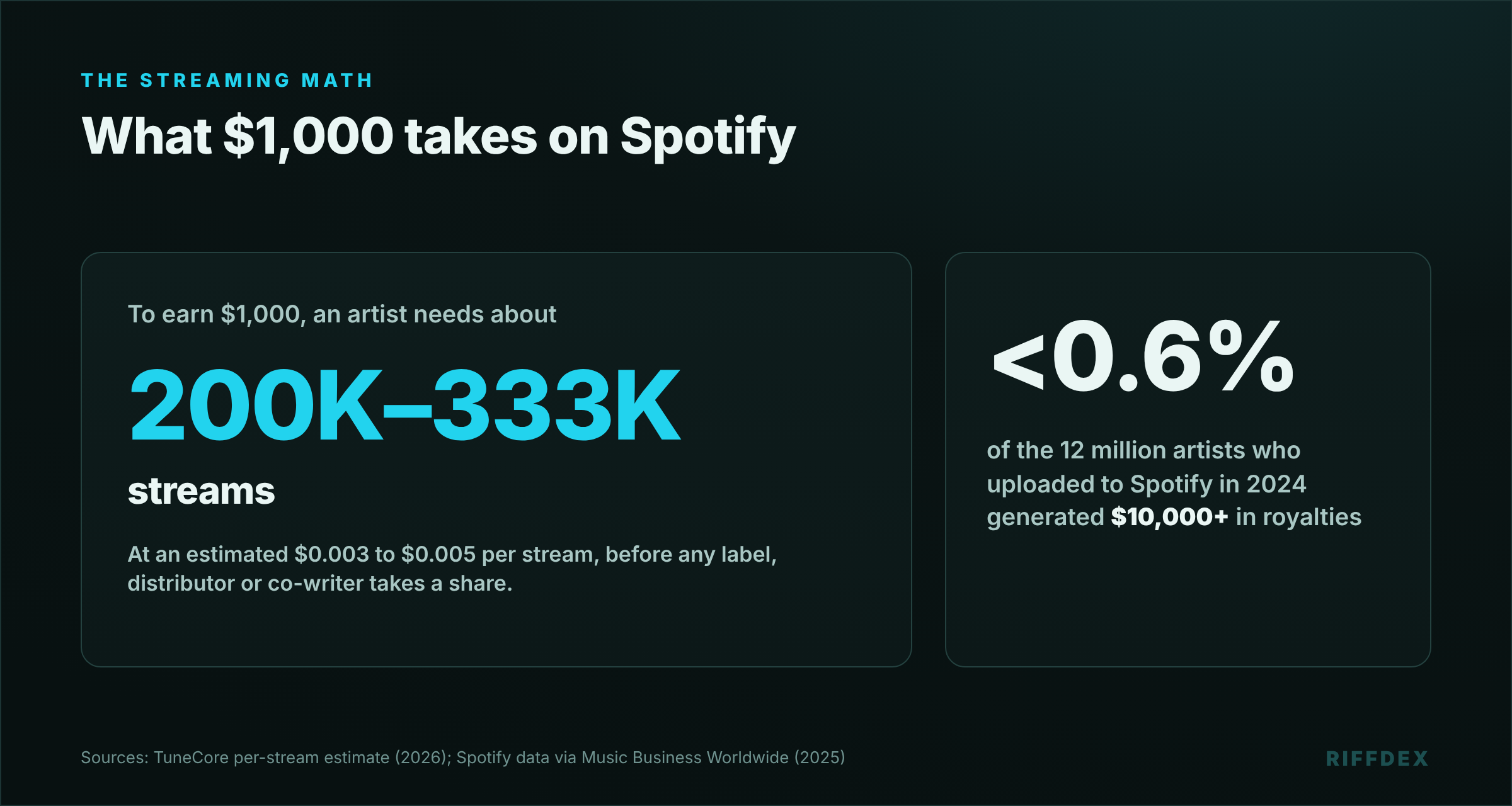
But look at it from the average artist's side. Spotify doesn't pay a fixed rate per stream. It shares a pool of revenue, and distributors estimate the result at roughly $0.003 to $0.005 per stream. At those rates, an artist needs somewhere between 200,000 and 333,000 streams to earn $1,000, and that's before a label, distributor or co-writer takes their share.
In 2024, 12 million artists uploaded music to Spotify. Fewer than 0.6% of them generated $10,000 or more in royalties.
Since the end of 2023, tracks need at least 1,000 streams a year to earn anything on Spotify. Spotify says those tracks made up about 0.5% of streams, and that the change redirects money to artists with more listeners. That's a reasonable argument for the platform. For the artist who sits under that line, it means their music earns nothing at all.
"There's too much music for mine to be heard"

In 2025, about 106,000 new tracks were delivered to streaming services every single day, according to Luminate. There are now around 253 million tracks on those services. 88% of them had 1,000 streams or fewer last year. Nearly half, about 120 million tracks, got between zero and ten plays.
AI has added a new layer to this. In June 2026, Deezer said more than half of the tracks uploaded to its platform each day were AI-generated, around 90,000 a day.
When the supply of music is effectively unlimited, the old model of earning a sliver from each play gets harder every year. The value moves away from the play and toward the relationship. The songs that last are the ones real people choose to care about.
"I spend more time making content than making music"
Discovery has moved to social video, and artists know it. In Ditto's survey, 86% of artists create social content to promote their music, three in four believe social media success is essential to a music career, and 67% say social video platforms are their biggest source of new fans. Only 1% named editorial playlists.
So the job has quietly expanded. An artist today is a songwriter, performer, video producer, editor, community manager and marketer, often while holding down another job. Financial pressure, self-promotion and balancing a day job are the top sources of stress. Creative block came last.
"The money arrives late, and some of it never arrives"
For artists signed to traditional record deals, royalty rates of roughly 15% to 25% are common, and the label recoups its advance and costs from the artist's share first. In a typical example, a $50,000 advance at a 20% royalty means the record has to earn $250,000 before the artist sees another dollar. Commonly cited industry estimates suggest most major-label releases never recoup. That doesn't make labels the enemy. Many artists choose that trade for the funding and reach it brings. But it explains why so many artists feel the money moves slowly and rarely in their direction.
Even when money is owed, finding it is hard. When the Mechanical Licensing Collective launched in the US, streaming services handed over more than $424 million in historical royalties they hadn't been able to match to the right songwriters and publishers. Royalty reports are slow, opaque and arrive months after the music was played.
"Touring costs more than it pays"
Live music is supposed to be where artists make their money back. For most independent artists, it's out of reach. 82% of the artists in Ditto's survey said they can't currently afford the expenses of touring, and two-thirds of those who perform live say touring costs have gone up.
On the road, venues commonly take 20% to 25% of an artist's merch sales, and some large venues reportedly take 30%. Artist groups on both sides of the Atlantic have campaigned against these fees, because for a small act, the merch table is often the difference between making a tour work and losing money on it.
"My biggest fans get nothing for believing in me early"

This is the one that matters most to me.
Every artist knows who their real supporters are. Spotify's own data shows that its "super listeners," about 2% of listeners, account for 18% of streams and half of concert ticket sales through the platform. A small group of people is carrying a big share of every artist's career.
The industry has noticed. Superfan products, premium tiers and fan clubs are now the talk of every music business conference, and Spotify has been reported to be preparing a superfan tier of its own. That's a good sign. But most of these ideas still treat superfans as people to sell more things to. Very few give fans a stake in the thing they actually love, the music itself.
People have tried. A multi-platinum songwriter recently told me she once sold 20% of her streaming royalties to her fans, and said they'd probably never see a meaningful return, though it was a cool thing to do. I lived my own version of this. A few years ago I sold more than 200 music NFTs in a single day. The demand was real. Fans wanted to own something real from an artist they believed in. But the structure underneath wasn't built for music. Once fans bought in, there was almost nowhere for that ownership to go, and royalties on resales only existed if a marketplace chose to honor them.
The lesson I took from that wasn't that fans don't want to own music. It was that we'd been giving them the wrong thing to own.
Why change is inevitable
None of this is new. What's new is that the conditions for change are finally lining up.
Artists are already going independent. Independent artists and labels now account for close to half of the recorded music market by ownership. In Ditto's survey, only 13% of artists said a major-label deal was most likely to accelerate their career, the lowest of any option.
The value is shifting to superfans. When there are 100,000 new songs a day, attention is cheap and loyalty is priceless. The industry's own data says a few percent of fans drive half the ticket sales.
The pressure is public. In the US, the Living Wage for Musicians Act, which proposes paying artists at least a penny per stream, has been introduced in Congress. Whatever happens to that bill, it shows how far the conversation about artist pay has moved.
And the technology finally fits. A few years ago, sending a fraction of a cent to an artist every time a fan traded a song would have cost more in fees than the payment itself. Today it doesn't. Ownership, payment and a live price for a song can all happen in the same moment, in the open, with no quarterly wait.
Where Riffdex fits
This is why I built Riffdex.
Riffdex turns a song into something fans can actually own. I call it an AFT, an Audio Fungible Token. Owning it unlocks the song. Many fans can own the same song, and they can buy and sell it whenever they want.
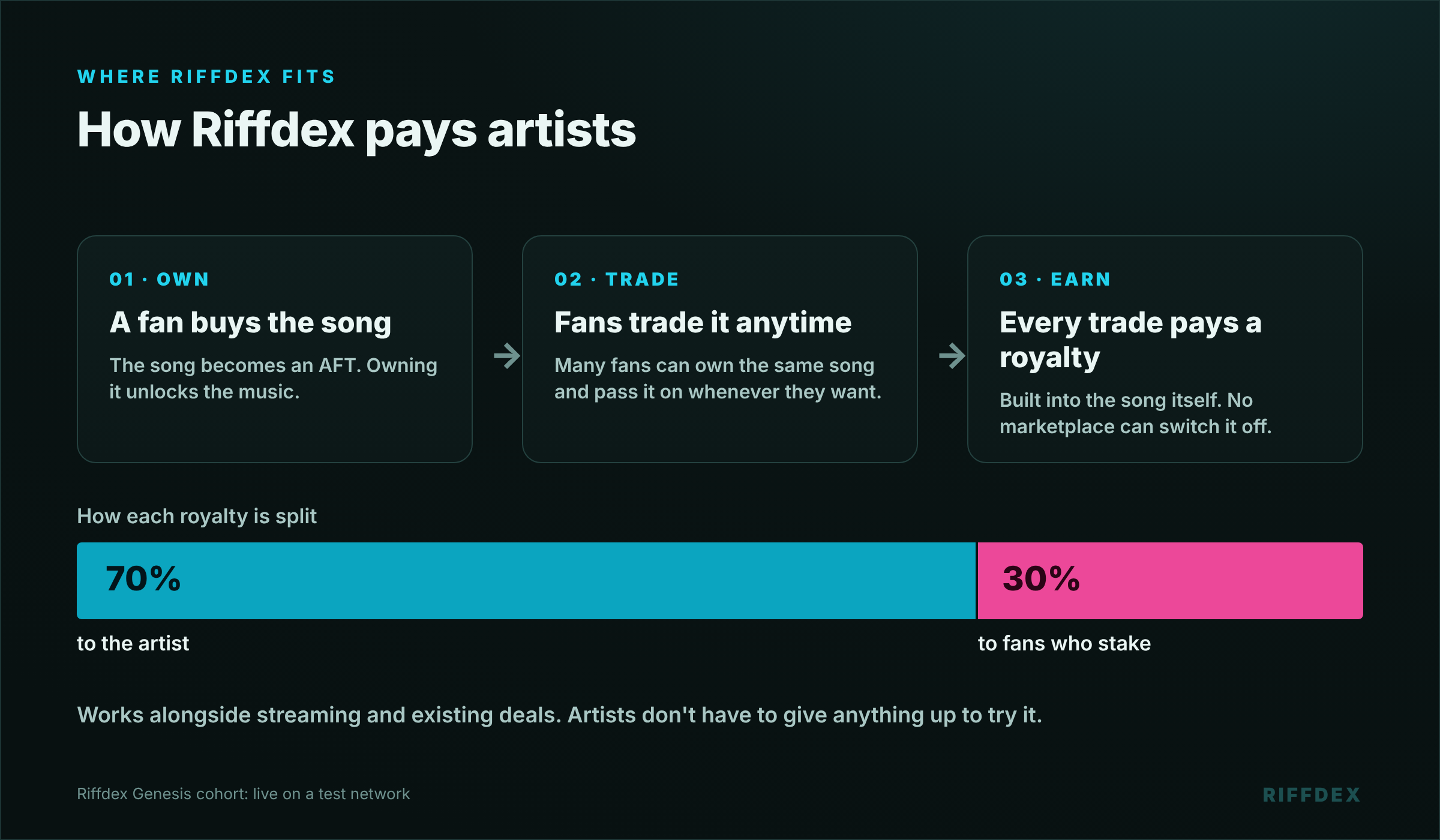
The royalty is built into the song itself. Every time it changes hands, a royalty is paid automatically: 70% goes to the artist, and 30% goes to the fans who stake and support the song. No distributor in the middle, no statement six months later, no marketplace deciding whether to honor it. The artist earns on the first sale and every trade after it, and anyone can see it happen.
Here's what that changes for an artist:
Your income grows with your fans, not just your streams. You don't need a million listeners. You need people who care enough to own a piece of your music. I wrote about this in You Don't Need a Million Fans. You Need 500 Real Ones.
Your earliest supporters become part of the story. The fans who found you first finally hold something real, and they have a reason to keep showing up, sharing and supporting.
Your royalty can't be switched off. It lives inside the song, not in a platform's policy.
You don't have to choose. Riffdex doesn't ask you to leave streaming or stop touring. It adds something the current system never offered: a way for fans to own your music, and for you to get paid every time it moves.
Riffdex is live today on a test network, and I'm inviting a small first group of independent artists into our first launch, the Genesis cohort. Fans who join get test tokens to buy their artist's song, so they can try the full experience before mainnet with nothing to pay or set up.
The music industry has changed how we listen, how we discover and who gets to release. The next change is about who gets to own and who gets paid. I'd rather artists lead it than watch it happen to them.
If you're an artist and this speaks to you, join the Genesis cohort. If you just want to see it working, the live market is here.
Stephen Heuvel (Melk)
About the author
Melk is the artist name of Stephen Heuvel, a self-taught builder and musician from Suriname and founder of Riffdex. One of the first artists to put his music on-chain, he sold more than 200 music NFTs in a single day. The experience left him convinced the format was wrong for music, so he spent two years building the AFT.
Follow Stephen on X or Farcaster. Follow Riffdex on X.
Sources
Ditto Music, The Independent Music Report 2026
Help Musicians and the Musicians' Union, Musicians' Census, via Classic FM
IFPI Global Music Report 2026, via Music Business Worldwide
Spotify, Loud & Clear 2026 highlights
Music Business Worldwide, 12m artists uploaded music to Spotify last year
TuneCore, How much does Spotify pay per stream
RouteNote, How Spotify's 1,000-stream threshold affected indie artists
Luminate 2025 Year-End Report, via Hypebot
TechCrunch, Deezer says more than 50% of daily uploads are AI-generated
Orphiq, Recoupment explained
Billboard, Venue merch fees
Music Business Worldwide, Super listeners are 2% of streamers but buy 50% of concert tickets
Music Business Worldwide, Spotify to launch Music Pro superfan tier (report)
MIDiA Research, via RouteNote: Independent music hits record 46.7% ownership
Hypebot, Rashida Tlaib to reintroduce the Living Wage for Musicians Act