On-chain fee-sharing is suddenly everywhere. Tools now route a token's trading fees straight to an X account and pay them out in dollars through X Money. Headlines describe people being "financially DDoS'd," with tens of thousands of dollars landing in creators' and influencers' accounts overnight. It looks like the future arriving early: value flowing automatically, on-chain, to real people, in real money.
It is worth slowing down and reading the mechanic precisely, because the framing is more generous than the reality.
What is actually happening
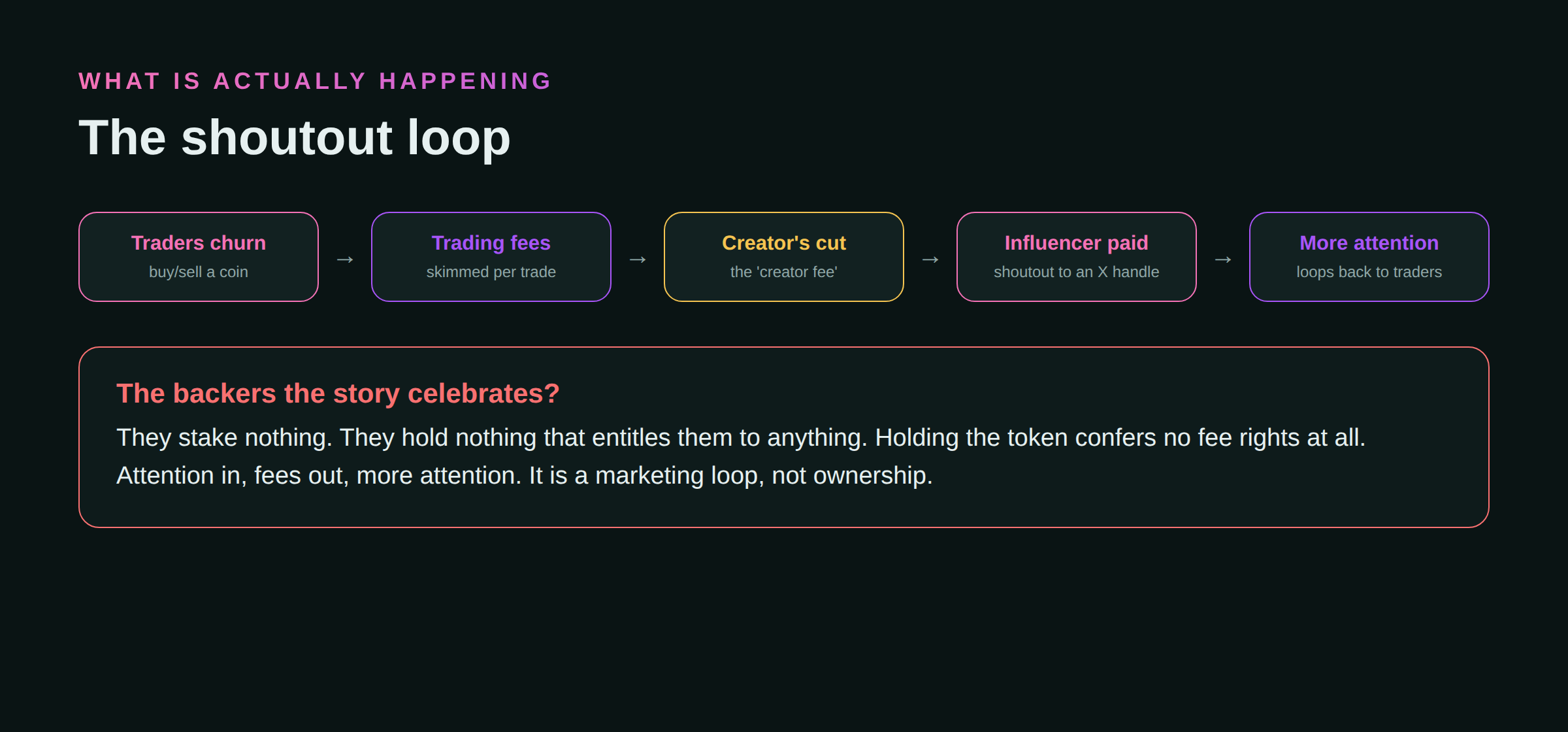
The fees come from trading volume. On a launchpad like pump.fun, every buy and sell pays a fee, and a small slice of that is assigned to the token's creator as a "creator fee." Services like UsePaid then let the creator point that fee stream at any X handle, claim it on-chain, convert it to dollars, and send it through X Money. The more a coin is bought and sold, the more fees it throws off.
Notice who is involved and who is not. The person receiving the money is the creator, or an influencer the creator is paying for reach in exchange for a shoutout. The people generating the fees are traders churning in and out of a speculative coin. And the "backers" the story celebrates put in nothing, hold nothing that entitles them to anything, and carry no ongoing stake in the outcome. Holding the associated token confers no fee rights at all. This is not supporters sharing in a project's success. It is a marketing loop: attention in, fees out, more attention.
That is not a criticism of the cleverness. It is clever. But it is important to name what it is, because the market is about to learn the wrong lesson from it.
The real signal

The right lesson is that programmatic, on-chain fee-sharing works, and people love it. Money that used to sit trapped in opaque intermediaries can now move automatically to a wallet or an account the moment it is earned. That is a genuine unlock, and the enthusiasm is real.
The missing piece is ownership. In the current shape, fees flow from a creator to whoever has the largest following. The far more powerful version is fees flowing to the people who actually backed the project early, because they own a piece of it. Not a shoutout economy. A stake economy. The difference is whether the person on the other end took on real conviction and holds a real position, or simply had an audience worth renting.
Once you frame it that way, the question stops being "how do we route a creator's cut to an influencer" and becomes "how do we let the people who believe in something early own it and share in everything it earns from then on." That is a different design, and it needs a different asset.
Why music is the asset this was waiting for

A song is one of the few things almost everyone already has a relationship with, and it generates value every single time it changes hands or gets consumed. It is a recurring cultural cash-flow asset that, until now, fans could never own a piece of.
This is what Riffdex is built for. A song becomes an AFT, an Audio Fungible Token: a fungible, royalty-bearing token that charges a fee on every transfer and splits it on-chain, 70 percent to the artist and 30 percent to the fans who stake. Fans do not back a project by being famous enough to receive a payout. They back it by acquiring and staking the token, taking a real position, and in return they share in every trade of that song, forever.
Put the two models side by side. Memecoin fee-routing takes fees from speculative churn and sends them to a creator or a paid influencer, while ordinary holders earn nothing and stake nothing. An AFT takes fees from a real cultural asset people actually value and sends them to the artist and to the fans who put their conviction on the line. One rents an audience. The other gives the audience ownership.
Where this goes
Fee-sharing is not a fad, and it is not going away. It will keep spreading, because moving value automatically and transparently is simply better than the alternative. But the versions that matter in five years will not be the ones that pay influencers to point at a coin. They will be the ones where the people who showed up early actually own the thing they believed in and share in what it earns.
That is the whole thesis. Fee-sharing without ownership is marketing. Fee-sharing with ownership is a new asset class. We are building the second one, starting with the most universal asset there is.
AFTs, not NFTs.
Written by Melk — artist name of Stephen Heuvel, a self-taught builder and musician from Suriname, and the founder of Riffdex. I was one of the first artists to turn my music into an NFT (over 200 sold in a single day). It never felt right, so I spent the next two years building what music actually deserved: the AFT. Follow the build: @MelkRhm · Riffdex on X · Farcaster
Enjoyed this? Subscribe to get new posts on Riffdex, AFTs, and the future of music in your inbox.