The hottest narrative in crypto right now is bringing real-world assets on-chain. US treasuries are tokenized. Equities are tokenized. Gold is tokenized. Funds, credit, even slices of real estate are being wrapped into tokens and traded on rails that never sleep. The pitch is simple and correct: put real assets on-chain and you get instant settlement, global access, and round-the-clock markets.
And yet the industry has quietly skipped the most universal asset there is.
Not the biggest by dollar market cap. Stocks and real estate win that. Music is the biggest by reach. Almost nobody owns a share of Apple. Almost everyone on the planet has a relationship with music, in every country, every language, every income bracket, every single day. It is the most global, most consumed, most emotionally owned asset humanity has. Billions of people love it. And you still cannot own a piece of it.
Why music got left out

If tokenization is so obviously powerful, why did it pass music by? Three reasons.
First, music is messy. A song's rights are split across writers, performers, labels, publishers, and distributors, a tangle that scares off anyone trying to wrap it cleanly.
Second, music does not look like a stock. There is no share, no ticker, no exchange, no order book. There was nothing standard to tokenize, because the underlying asset was never structured as a tradable financial instrument in the first place.
Third, crypto's one real attempt used the wrong tool. When the space reached for music, it reached for NFTs, and an NFT is the wrong shape for a song. It treats a song as a scarce one-of-a-kind collectible when a song's value comes from how much it moves, not how rare it is. So the experiment fizzled, and the tokenization wave moved on to easier, more familiar assets.
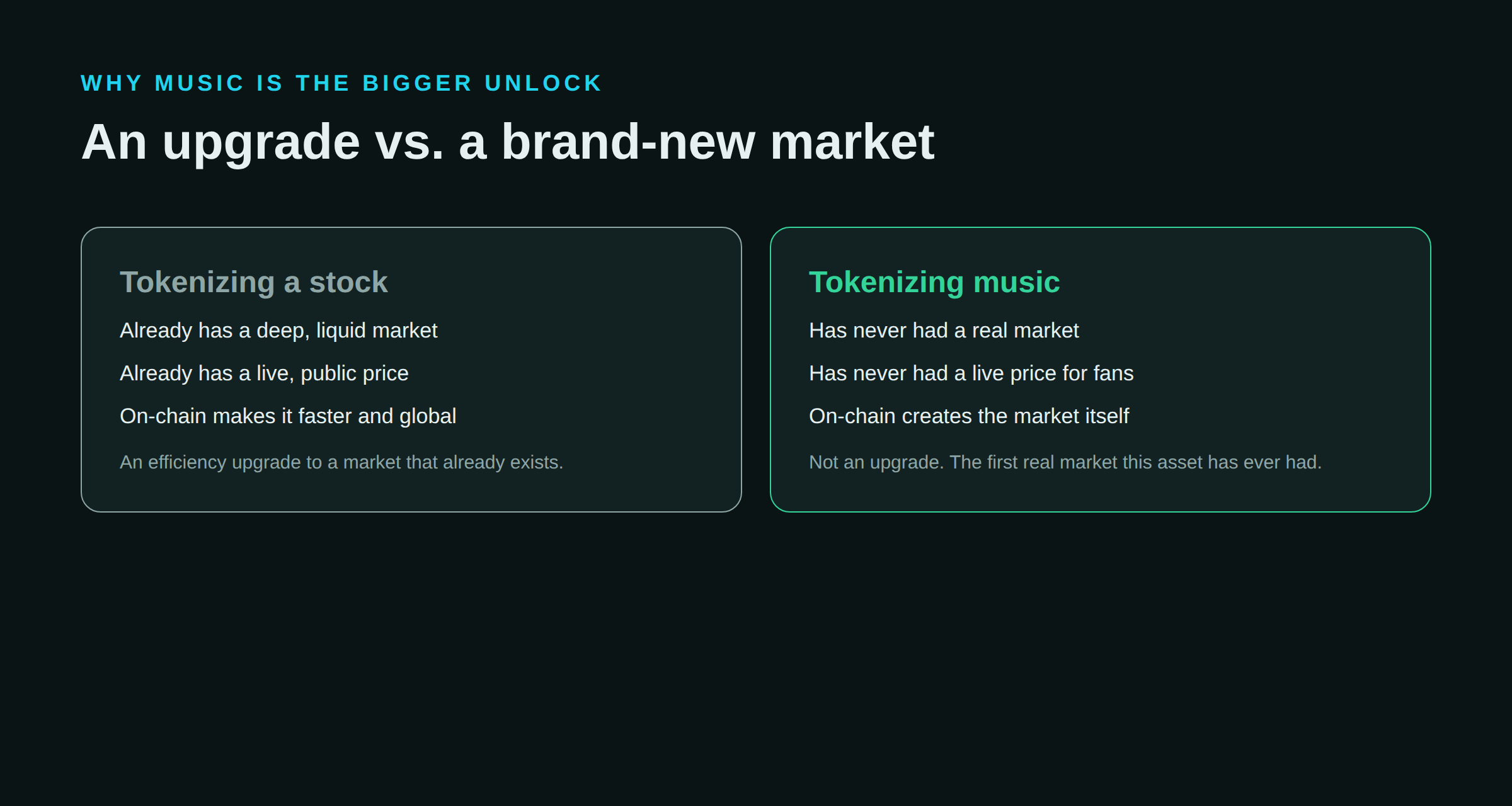
Tokenizing a stock is an upgrade. Tokenizing music is a creation.
Here is the part most people miss, and it is why music is the bigger opportunity, not the smaller one.
When you tokenize a stock, you are upgrading something that already works. Apple already has a deep, liquid, transparent market on the NYSE. Putting it on-chain makes trading faster and more global, a real improvement, but an improvement to a market that already exists.
When you tokenize music properly, you are creating a market that has never existed at all. There has never been a live, liquid, transparent market where a fan can own a piece of a song and an artist can earn from every trade. You are not making an existing market more efficient. You are giving an entire asset class its first real market, ever. That is a far larger unlock.
What tokenizing music actually takes
You cannot tokenize music by copying the stock playbook, because a song is not a share. It needs a token built around what a song actually is, and a market built to trade that token. Both, together.
That is exactly what Riffdex is. A song becomes an AFT, an Audio Fungible Token: fungible and divisible so fans can own a piece, with a royalty baked directly into the token so the artist earns on every single trade, forever. And because a royalty on every transfer breaks normal exchanges, Riffdex includes the exchange too, an AMM re-built to handle it cleanly. The asset and its market, designed as one system, on Base.
That is what real tokenization of music looks like. Not a jpeg of an album cover. The song itself, as a living, ownable, tradeable asset, with the artist paid automatically every time it changes hands.
The wave is not finished
The real-world-asset story is one of the most important things happening in crypto. But it will look strangely incomplete as long as it covers treasuries and tech stocks and skips the one asset that touches more human lives than any of them.
Stocks are tokenized. Bonds are tokenized. Gold is tokenized. The world's most global asset is still waiting.
That is the one we are building. AFTs, not NFTs.