
Every cycle, crypto asks the same question: where do the next million users come from? And every cycle, the honest answer is the same. They do not come for blockchains, wallets, or yield. They come for culture, for music, art, sports, and community, and they stay when the technology gets out of the way.
The projects that grow the pie do not teach people crypto. They give people something they already want, and quietly put it on-chain underneath. That is the whole game, and most builders get the order backwards.
The mistake: leading with the technology

The instinct is to sell the rails. "It is decentralized." "It is trustless." "It is on-chain." These matter deeply to builders, and mean almost nothing to a fan who just wants to support an artist they love. Leading with the technology filters your audience down to people who are already here. It cannot bring in anyone new, because the pitch only lands on people who already speak the language.
Culture does not need to learn crypto. Crypto needs to disappear behind culture.
The pattern that works

Look at what has actually pulled non-crypto people on-chain, and a pattern appears. The winners share three traits.
They start from an existing love, not a new behavior. People already have deep, emotional ownership feelings about songs, teams, artists, and moments. You do not have to manufacture demand. You have to give an outlet to demand that already exists.
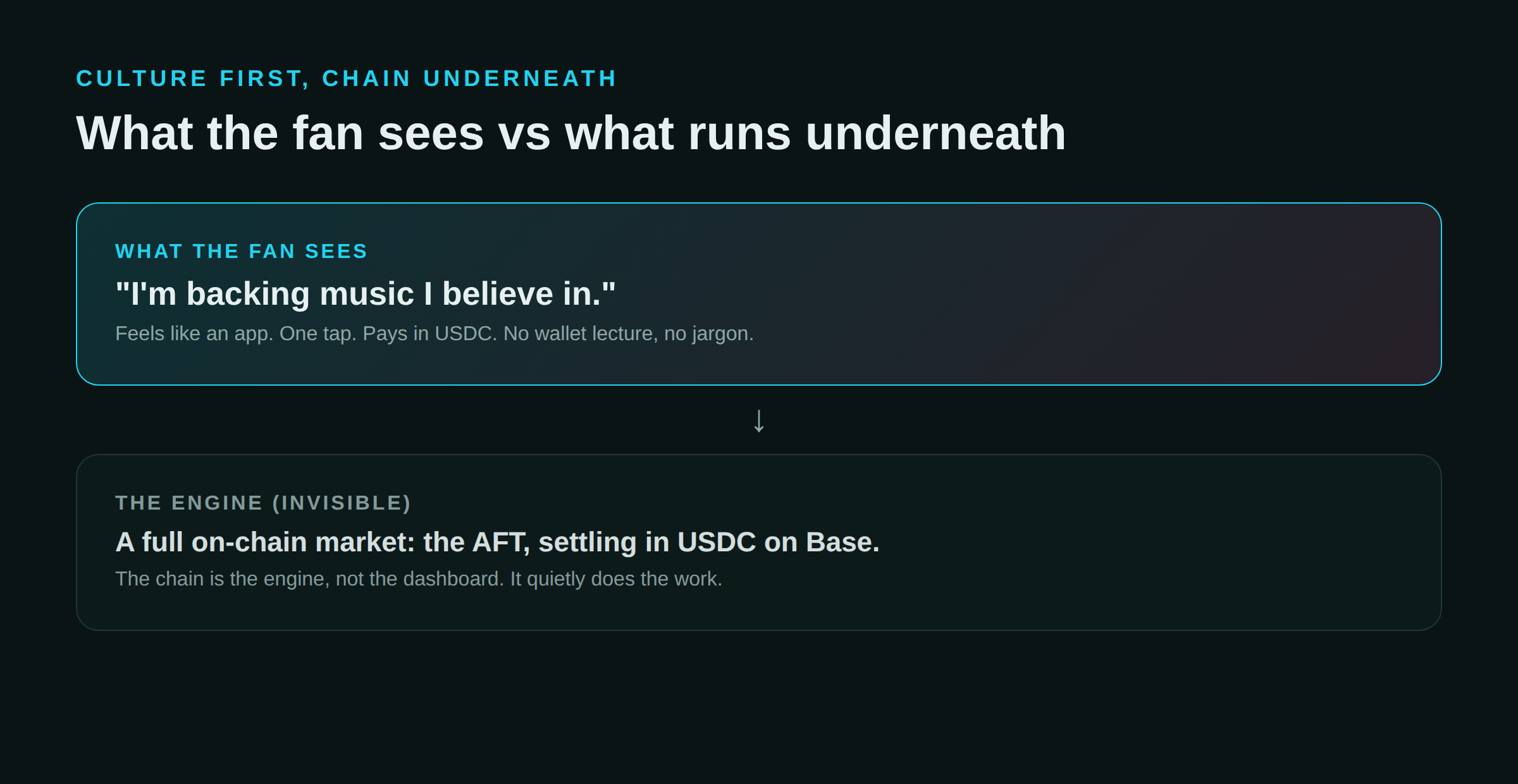
They make the on-chain part invisible. The best experiences feel like an app, not a protocol. USDC instead of a volatile token. One tap instead of a seed phrase lecture. The chain is the engine, not the dashboard.
They give the fan real skin in the game. Not a jpeg to flip. A genuine stake in something they care about, where their early belief is rewarded if they are right. Ownership that means something, not a speculative side quest.
Where Riffdex fits
Riffdex is built on exactly this thesis. The love already exists: billions of people care about music more than almost anything else they consume. What has never existed is a way for a fan to own a piece of a song and earn alongside the artist as it grows.
Riffdex turns a song into an AFT, a token a fan can buy, hold, and trade, where the artist earns a royalty on every trade and early fans share in the upside. To the fan, it feels like backing music they believe in. Underneath, it is a full on-chain market settling in USDC on Base. The chain is invisible. The feeling is the point.
That is how you bring a new audience on-chain: not by convincing music fans to become crypto users, but by giving music fans a better way to do the thing they already do, and letting the chain quietly do the work.
Why this matters for the whole ecosystem

An on-chain economy full of people trading the same tokens with each other is not growth, it is circulation. Real growth is a new kind of person showing up for a new reason. A musician in Lagos launching a song. A fan in Manila owning a piece of it. Neither of them thinking about the blockchain at all.
That is the bridge. Not a lecture about decentralization, but a doorway shaped like the thing people already walked toward. Build the doorway, hide the machinery, and the users who never cared about crypto will walk through it anyway, for the culture they already love.
AFTs, not NFTs. Culture first, chain underneath.
Written by Melk — artist name of Stephen Heuvel, a self-taught builder and musician from Suriname, and the founder of Riffdex. I was one of the first artists to turn my music into an NFT (over 200 sold in a single day). It never felt right, so I spent the next two years building what music actually deserved: the AFT. Follow the build: @MelkRhm · Riffdex on X · Farcaster
Enjoyed this? Subscribe to get new posts on Riffdex, AFTs, and the future of music in your inbox.