
For three years, crypto has been obsessed with one question it keeps answering badly: how do you make an NFT liquid?
The instinct is understandable. NFTs locked billions of dollars of cultural value behind an asset shape that cannot trade well. One-of-one, indivisible, priced by auction, dead on the secondary market for months at a time. So the industry kept trying to bolt liquidity onto scarcity. Fractionalization vaults. Wrapping protocols. And in February 2024, the boldest attempt of all: ERC-404, a token that tries to be a fungible ERC-20 and a unique ERC-721 at the same time.
ERC-404 is a fascinating, instructive failure. And understanding exactly why it broke is the clearest possible way to understand why AFTs are built the way they are. Because we looked at the same problem and drew the opposite conclusion. We did not build a hybrid. We refused to.
This is the technical argument for why.
What ERC-404 actually does, and where it bleeds

ERC-404 packs two token standards into one contract. Balances behave like an ERC-20. But cross an integer boundary and the contract mints or burns an NFT to match. Hold one whole unit and an ERC-721 appears in your wallet. Sell enough that your balance drops below 1.0 and that NFT is burned. Buy back up and a new one is minted, historically with a different ID and different traits.
It is clever. It is also a machine for producing edge cases. Look at where it bleeds:
Interface collision. A single contract exposing both ERC-20 and ERC-721 has to overload functions that mean different things in each standard. transferFrom(address, address, uint256) is the canonical example: in ERC-20 that third argument is an amount, in ERC-721 it is a token ID. When the same function has to guess which one you meant, wallets, indexers, and DeFi protocols guess differently. That is not a cosmetic bug. That is ambiguity at the most security-sensitive entry point a token has.
Mint and burn on transfer. In a normal ERC-20, a transfer updates two balances. In ERC-404, a transfer can also trigger NFT minting and burning as balances cross whole-number thresholds. That means more state changes, more external calls, more gas, and more surface for reentrancy and ordering bugs on the single most frequently called path in the whole system. The 2024 launch wave spiked Ethereum gas precisely because ordinary trades were doing extraordinary work.
The vanishing asset. Because the NFT is tied to your balance crossing 1.0, "your NFT" is not really yours in any durable sense. Sell 0.01 of a token and the collectible you were attached to can be burned. Its traits can change when you rebuild a full unit. An asset whose identity depends on a moving balance is an asset that can evaporate underneath the holder.
Threshold MEV. Any time a discrete event fires at a precise numeric boundary, you have created a game. Bots can sit on the 1.0 line, forcing mints and burns to farm traits or arbitrage rarity. The mechanism invites exactly the adversarial behavior a token should avoid.
The ecosystem itself flagged this. Within days, DN-404 appeared, splitting the design into two synchronized contracts, a base ERC-20 and a mirror ERC-721, so each standard keeps its own clean interface. That approach was later formalized as ERC-7631, a Final ERC, which even lets users opt out of NFT synchronization entirely. The correction is telling: the fix for a hybrid was to stop cramming two natures into one contract. And even now, in late 2026, the whole category sits at roughly a million dollars of market cap, thinly traded, with the reference implementations still labeled experimental and not fully audited for production.
That is not a standard. That is a warning.
The engineering sin underneath all of it
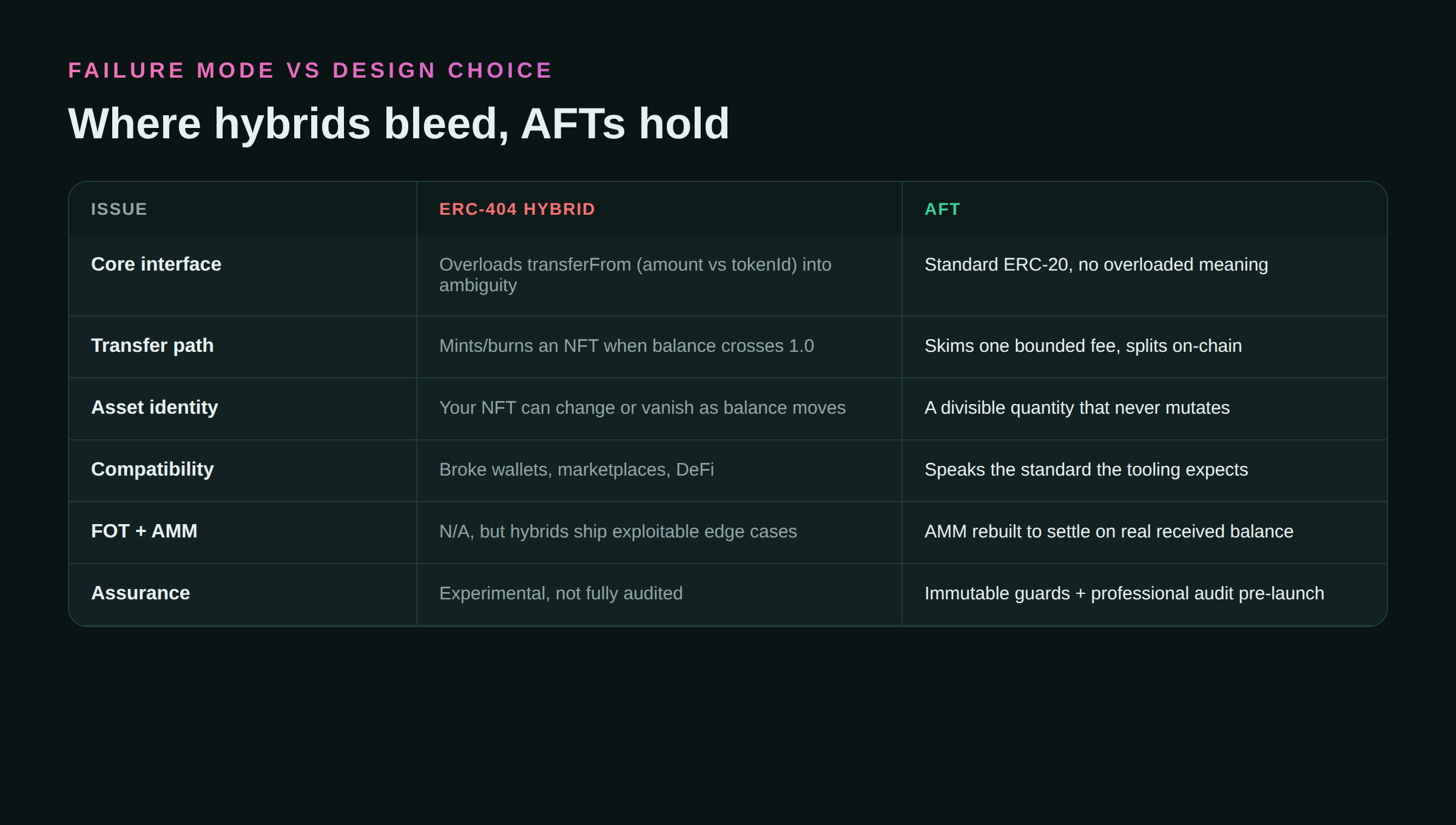
Every one of those failure modes traces back to a single decision: forcing an asset to be two contradictory things at once. Scarce and fungible. Unique and divisible. Collectible and currency.
Complexity is not a neutral cost in smart contracts. Complexity is attack surface. Every overloaded function, every conditional mint, every state transition that fires on a hot path is another place for value to leak. The history of DeFi exploits is not a history of exotic math being broken. It is a history of edge cases nobody modeled. ERC-404 is edge cases by design.
So when we set out to make music ownable, we asked a different question. Not "how do we make an NFT liquid," but "what is a song actually shaped like?"
A song was never scarce
Here is the premise that changes everything. A song's value does not come from rarity. It comes from spread. The more a song moves, the more it is heard, shared, and traded, the more valuable it becomes. That is the exact opposite of a collectible, whose value depends on there being only one.
Wrapping a song in an NFT was a category error from the first day. And wrapping it in a hybrid, half NFT and half coin, is that same error with more moving parts. The right primitive for a song is not a compromise between fungible and unique. It is simply fungible. Fully. Natively. Without apology.
That is what an AFT is. An Audio Fungible Token is a fee-on-transfer ERC-20. One nature. One clean interface. No mirror contract, no threshold minting, no collectible that vanishes when you sell a fraction. What makes it special is not a second token standard bolted on top. It is the economics living inside a well-understood one.
Where the innovation actually lives
An AFT charges a royalty on every transfer and splits it on-chain: the majority to the artist's immutable wallet, the rest to the fans who stake. The artist earns on the first sale and every trade after it, forever. Early fans share in the upside they helped create. Ownership flows to the people who generate the value.
Crucially, the cleverness is in the economic layer, not in a Frankenstein token. And that is the whole safety argument. Compare the surfaces directly:
Where ERC-404 overloads transferFrom into ambiguity, an AFT keeps standard ERC-20 semantics that every wallet, indexer, and protocol already understands. Where ERC-404 mints and burns NFTs on the transfer path, an AFT does one contained thing on transfer: it skims a bounded fee and splits it. Where ERC-404's asset identity depends on a moving balance, an AFT holder simply owns a divisible quantity that never mutates or disappears. Where ERC-404 invites threshold MEV at the 1.0 line, an AFT has no discrete boundary to game.
Fee-on-transfer is not free of danger, and this is the part that should earn your trust rather than lose it. A naive fee-on-transfer token breaks standard AMMs, because the pool never receives the exact amount the sender specified. Most projects either ignore this and ship something exploitable, or block DeFi integration entirely. We did neither. We rebuilt the AMM to settle on the real balance actually received after the fee, and to run the trade on that. The constant-product curve, the reserves, the custody, and the LP accounting all behave exactly as a rigorous exchange should, with no fee mismatch left to trip over. The asset and its market were designed as one system, so the one genuine footgun of fee-on-transfer is engineered out rather than papered over.
On top of that sit the guarantees that make the token anti-rug by construction. The artist address is immutable and cannot be swapped. The fee is bounded, not arbitrary. Pricing runs through a TWAP checked against a Chainlink feed, with an immutable de-peg guard that blocks any price-sensitive action when the internal price and the external reference diverge beyond a fixed threshold. No admin can quietly widen that threshold later. And the whole protocol goes through a professional security audit before a single dollar touches mainnet.
That is what "safe" actually means. Not a label. A smaller, standard-compliant surface, the known footgun of fee-on-transfer explicitly neutralized, and an independent audit to certify it.
The lesson, stated plainly
ERC-404 and AFTs are the two forks of the same road, and the contrast is the whole thesis.
Match the token to the asset. ERC-404 forced liquidity onto scarcity and inherited every contradiction that follows. AFTs chose the primitive the asset was always shaped like, and the contradictions never arise.
Keep the token boring, and put the genius in the system. The safest tokens are the least surprising ones. Innovation belongs in the market design and the incentive layer, not in a contract pretending to be two standards at once.
Work with the ecosystem, not against it. ERC-404 broke wallets and marketplaces and had to be rescued by splitting into two contracts. An AFT speaks standard ERC-20, so the entire tooling stack already knows how to hold it.
And the strategic truth underneath all of it: the market keeps trying to make NFTs liquid because it started from the wrong asset shape. AFTs make the question disappear. You do not need to fractionalize, wrap, or hybridize a song to give it liquidity, if you never made it scarce in the first place.
We did not build a hybrid. We built the token music was always supposed to be.
AFTs, not NFTs. And not hybrids either. Fungible by design.
Written by Melk — artist name of Stephen Heuvel, a self-taught builder and musician from Suriname, and the founder of Riffdex. I was one of the first artists to turn my music into an NFT (over 200 sold in a single day). It never felt right, so I spent the next two years building what music actually deserved: the AFT. Follow the build: @MelkRhm · Riffdex on X · Farcaster
Enjoyed this? Subscribe to get new posts on Riffdex, AFTs, and the future of music in your inbox.